
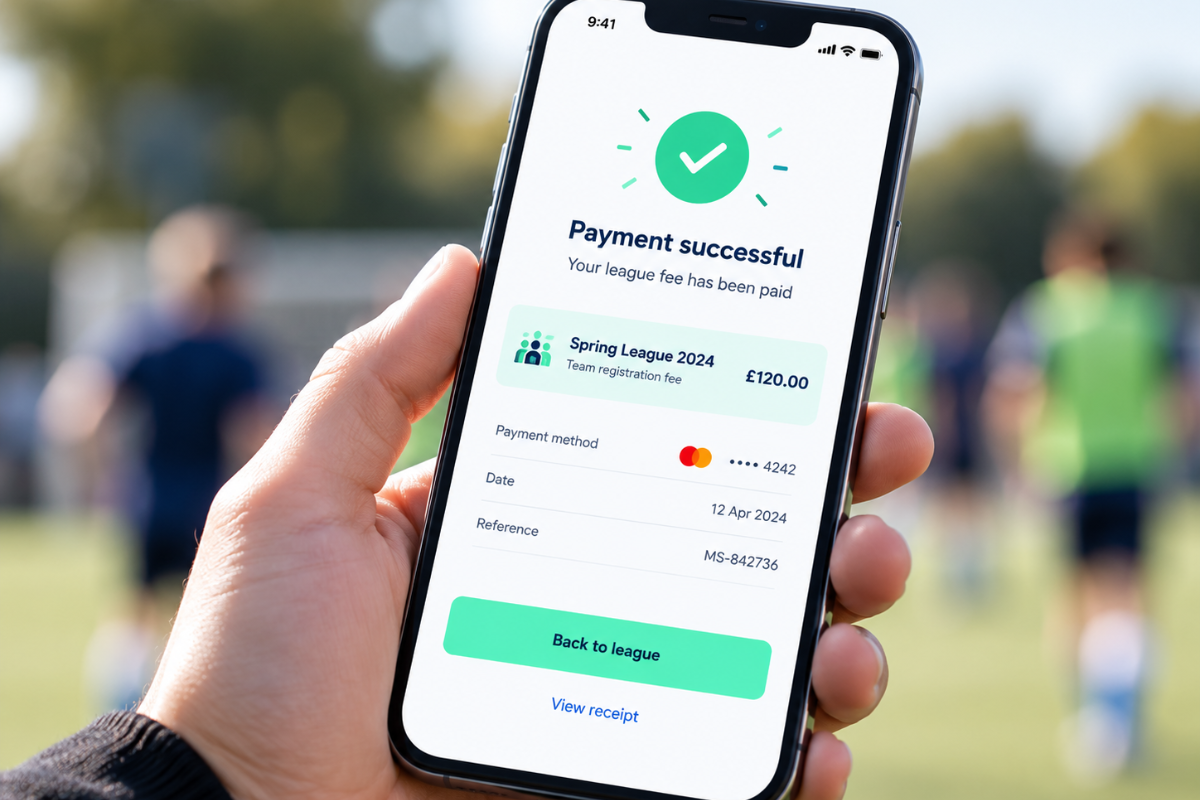
Nobody starts a league because they fancy spending Sunday night matching bank transfers to team names. Yet payments are one of the quickest ways for a simple league to turn into a weekly admin job if the rules are not clear from the beginning.
Before the first payment is due, decide who is paying, when the money should arrive and what happens when it does not. A good setup will not stop every late payment, but it will make the process predictable for you and for the teams.
By the end of this step, you should have: A collection process with clear responsibility, due dates, reminders, overdue rules and a simple way to see what is still owed.
Start with three basic questions
Do not reopen the pricing maths here unless something material has changed. Step 4 decided what the league needs to charge; this step turns that decision into a collection process.
Your payment setup should begin with three decisions: who are you charging, when are they paying and what happens if they miss the deadline?
Those answers shape everything else. A league charging full teams per season needs a different process from one where individual players pay each time they play.
Decide who carries the payment responsibility
Some leagues charge the team and leave the captain to collect money from players. That keeps things simple for the organiser, but it can turn the captain into the person doing all the chasing.
Other leagues charge players directly, either for each fixture or through a membership. You can also split team charges across players so the captain is not automatically footing the whole bill.
There is no single correct approach. Think about the type of league, how teams are formed and who is most likely to keep the process moving smoothly.
Choose when payments are collected
You may already have decided the broad pricing model, but now you need to turn it into an actual collection process.
- Per season: one main fee covering the season, sometimes split into instalments
- Per fixture: teams or players pay each time they play
- Registration fee: a one-off charge to confirm a place before the season starts
- Hybrid: an initial entry fee plus match-by-match charges
- Membership: recurring payments for players where that suits the league model
The best option is the one that balances affordability for the people joining with enough certainty for you to pay venues, officials and other league costs.
Set the due dates before you send the first invoice
Avoid vague rules such as “pay before the season starts” or “fees are due around match day”. Give people an actual deadline and make it clear what the payment relates to.
If you are charging per fixture, decide whether payment is due before or after the match. If you are using instalments, publish the dates upfront so captains are not surprised halfway through the season.
Decide what happens when somebody does not pay
This is much easier to agree before you have an overdue team in front of you. Will they receive reminders? Is there a grace period? Can they continue playing while a balance is overdue? Are there late charges or a no-pay, no-play rule?
Whatever you choose, consistency matters. If one team is chased immediately and another is allowed to build up weeks of unpaid fees, you create confusion and potentially resentment.
Take the captain out of the firing line where you can
In team-based leagues, captains often end up paying the full fee and then spending the week asking teammates for their share. That is not much fun for them and it can become another reason good captains decide they have had enough.
If your setup allows individual contributions or shared team payments, use them where they make sense. Even if the captain remains responsible for the team overall, giving players a direct route to pay can remove a lot of unnecessary chasing.
Automate the reminders, not the relationship
Payment reminders are repetitive, which makes them a perfect job to automate. A sensible sequence might include a reminder before the due date, a message when payment becomes due and a follow-up when it is overdue.
That means you only need to step in personally when somebody genuinely needs help or a payment has become a problem. You keep the human conversation for the situations that need one rather than spending your week sending the same message to everybody.
Plan for refunds, credits and cancellations
Fixtures get postponed. Teams withdraw. Venues sometimes disappear at short notice. Decide how those changes affect payments before they happen.
Will a cancelled fixture be refunded, credited against a future game or simply moved with the original payment attached to the new date? If a team has paid for a full season and leaves early, what does your policy say?
You do not need a rule for every imaginable scenario, but the common situations should not require a brand-new decision each time.
Keep one clear view of what is owed
However you collect payments, you should be able to see who has paid, who has not and what each balance relates to without digging through bank statements, emails and messages.
That visibility is what stops payment admin from snowballing. You can deal with the exceptions quickly instead of trying to rebuild the whole picture every time somebody asks what they owe.
Your payment setup check
- You know whether teams, players or both are responsible for payment
- You have chosen when each type of payment is collected
- Due dates are clear before the season starts
- Teams and players know what each charge covers
- There is a consistent process for overdue payments
- Captains are not being forced to do unnecessary chasing
- Reminder messages can be sent consistently
- Refunds, credits and postponements have a basic policy
- You can see outstanding balances in one place
Next step: create fixtures and launch
With the league structure, venue, pricing, registrations and payments in place, you are finally at the fun bit: turning the plan into an actual season and getting everyone to the first fixture without chaos.