
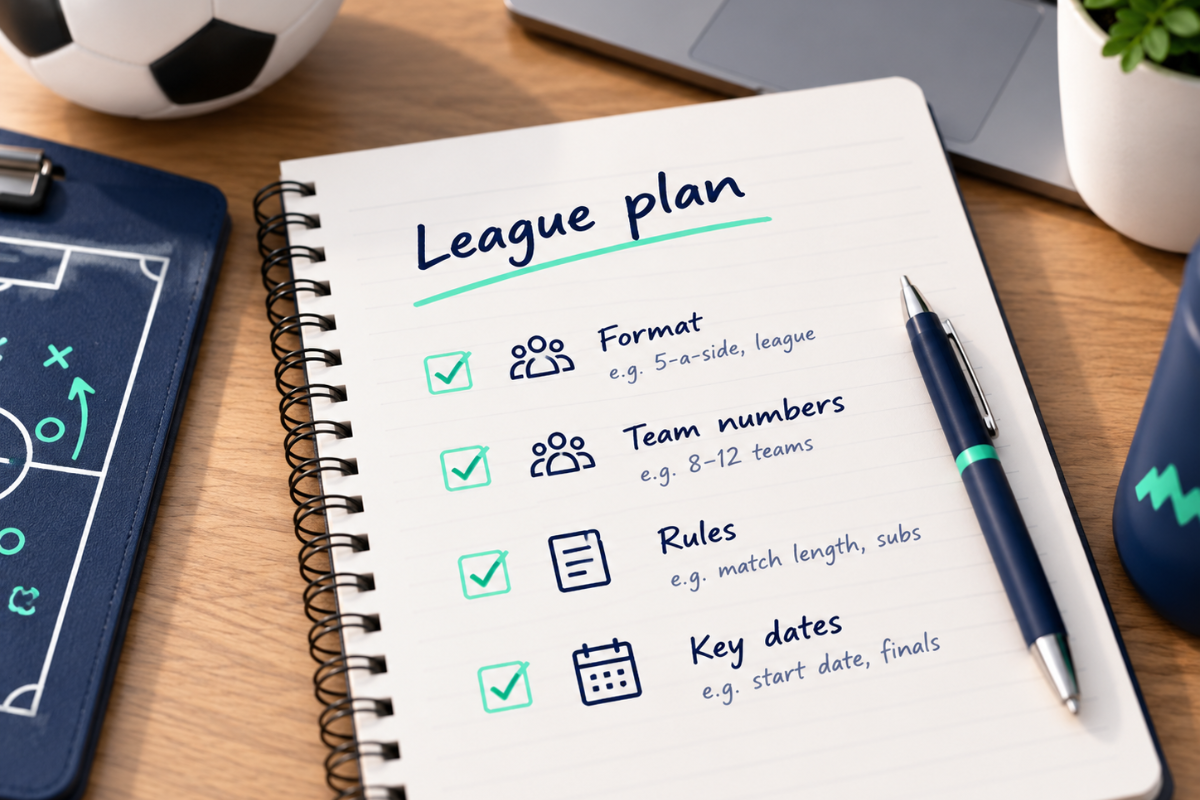
Once you know there’s enough interest in your idea, the next step is working out exactly what the league is going to look like.
This is where a lot of organisers are tempted to jump straight into venues, registrations and fixtures because those are the things that make the league feel real. The problem is that if the basic structure is still changing, every decision you make afterwards becomes harder. Players start asking questions you haven’t answered yet, pricing gets adjusted on the fly and you end up rebuilding fixtures because the format wasn’t properly decided in the first place. A bit of planning here saves a lot of admin later.
By the end of this step, you should have: A written league blueprint covering audience, format, season structure, rules, flexibility and what a successful first season should look like.
Decide what kind of league you actually want to run
The first thing to get clear on is the type of experience you want to create. Some leagues are built around competition, with stronger teams, tighter rules and a higher standard of officiating. Others are much more social, where the main aim is to give people a regular game in a relaxed environment. Plenty sit somewhere in the middle.
There’s no right answer, but there does need to be an answer. If you try to appeal to everyone, the league can quickly become muddled. A highly competitive team may expect something very different from a group of players who simply want an hour of sport after work. Being clear on the experience makes later decisions much easier. It affects how you promote the league, how you structure divisions, what rules you use and even the sort of officials you need.
Be clear on who the league is for
You should already have a good idea of this from checking demand, but now it needs to become part of the actual league plan. Think about who is most likely to play. Are they existing teams looking for another competition? Individual players who want to join without putting a full squad together? Beginners? More experienced players? Adults? Juniors?
This matters because the registration process, league format and communication can all change depending on who you’re dealing with. For example, a league built around individual registrations needs a plan for how those players get placed into teams. A league aimed at established clubs might need a more traditional team-entry process instead. The clearer you are now, the fewer awkward decisions you’ll be making once people start signing up.
Work out the format before you open registrations
This is the format on paper. Do not build the live fixture schedule yet; that comes in Step 7 once team numbers and venue dates are confirmed.
This is one of the biggest decisions to get right early. How many teams are you aiming for? Will you have one division or several? How many times will teams play each other? Will there be promotion and relegation? Are you planning playoffs, finals or just a straightforward league table?
You don’t need every detail locked down immediately, but you should have a structure that makes sense before asking people to join. A common mistake is opening registrations first and deciding the format once you know how many teams turn up. Sometimes you do need a bit of flexibility, but if too much is still unknown, you create unnecessary uncertainty for everyone involved. Teams want to know what they’re signing up to. The more you can answer upfront, the smoother the process becomes.
Decide how long the season will run
Season length has a bigger impact than it might seem. A longer season can give players more value and create a proper sense of competition, but it also means a bigger commitment for teams, venues and officials. A shorter season is easier to get off the ground, but may need more frequent relaunches or renewals.
Your chosen format will often determine the rough season length anyway. If each team plays every other team twice, the maths starts to do some of the work for you. The important thing is to think about the commitment from the player’s point of view as well as your own. A social league aimed at people fitting sport around work and family may need a different setup from a more competitive league where teams expect a longer season.
Get the rules sorted before the first disagreement
Rules are easy to ignore when everyone is excited about getting started. They become much more important the first time two teams disagree over what should happen. You’ll obviously need the rules of the sport itself, but you should also think about the league-specific decisions that cause most of the admin later.
- What happens if a team can’t fulfil a fixture?
- How are postponements handled?
- Can teams use replacement players?
- Are there limits on squad sizes?
- What happens if a player represents more than one team?
- How are points awarded?
- What happens if two teams finish level?
- What are the rules around late payments or withdrawals?
You don’t need to write a legal textbook. You just need clear rules that people can understand before the season starts. A lot of complaints come from situations where the organiser has to make a decision halfway through the season that nobody had discussed beforehand. Writing the rule down early makes life much easier.
Think about the player experience, not just the admin
It’s easy to plan a league entirely from the organiser’s point of view. The fixtures work, the venue is available and the numbers add up. But players experience the league very differently. They care about things like whether matches start on time, whether the standard feels right, whether the officiating is consistent, whether fixtures are easy to find and whether they know what happens when something changes.
Those things might seem small when you’re planning, but they have a big effect on whether people come back for another season. If you’re building a social league, you may want shorter matches, simpler rules or more flexibility. If you’re building something more competitive, players may care more about formal rules, stronger officials and clear promotion or relegation. The format should fit the audience, rather than forcing the audience into whatever format happens to be easiest to organise.
Decide how much flexibility you want
Every league needs a bit of flexibility, but too much can create chaos. If teams can postpone whenever they like, move fixtures with very little notice or constantly change availability, you may spend most of your week sorting out the knock-on effects. On the other hand, being too rigid can make life unnecessarily difficult for social teams that are balancing work, family and other commitments.
You need to decide where the line sits for your league. For example, you might allow fixture changes with enough notice, but not within a certain number of days. You might allow replacement players but still have rules around eligibility. The important thing is consistency. Whatever you decide, apply it the same way across the league.
Think about officials early
At this stage, the job is to define the officiating model: whether you need officials, how many and what standard. Recruiting and assigning them comes later.
If your sport needs referees, umpires or other match officials, include them in the plan from the start rather than treating them as something to sort out later. Think about how many you’ll need, whether they’ll work every week, what standard is appropriate for the league and how much they’ll cost.
Good officials have a big impact on how professional and enjoyable the league feels. Inconsistent officiating can quickly cause frustration, especially in more competitive divisions. If your league is more social, the priority might simply be finding reliable people who can keep the games moving and deal with decisions consistently. Either way, it’s worth knowing what you need before the first fixture is around the corner.
Decide what ‘a good first season’ looks like
It helps to think about this before the league launches. Success doesn’t have to mean filling ten divisions or making a huge profit in year one. For a new league, a good first season might simply mean filling one division, getting through the fixtures without constant problems and having enough teams wanting to come back.
That gives you something realistic to build on. Think about the measures that actually matter to you. That could include how many teams complete the season, how many return, how much admin you’re doing each week and whether the league covers its costs. You don’t need a dashboard full of numbers. Just a few useful measures that tell you whether the league is working as intended.
Write the plan down somewhere
This doesn’t need to become a 20-page business plan. A simple document covering the main decisions is enough. You want one place where you can quickly check the league format, target audience, season length, rules and the other decisions you’ve already made.
That stops important details being scattered across messages, notes and conversations. It also makes things easier if someone else starts helping with the league later. Instead of explaining everything from scratch, you already have the basic structure written down.
Your league plan should answer these questions
- Who is the league for?
- Is it social, competitive or somewhere in between?
- Will people join as teams, individual players or both?
- How many teams are you aiming for?
- How many divisions will there be?
- How often will teams play?
- Roughly how long will the season last?
- What are the main league rules?
- How will postponements and fixture changes work?
- What standard of officials will you need?
- What should the player experience feel like?
- What would make the first season a success?
If you can answer those comfortably, you’ve got enough structure to move onto the practical side of setting the league up.
Next step: find the right venue
Once the league itself is clear, you can start looking for somewhere that actually fits it. That means thinking about location, availability, cost, facilities and whether the venue gives you enough room to run the league properly now and grow it later.