
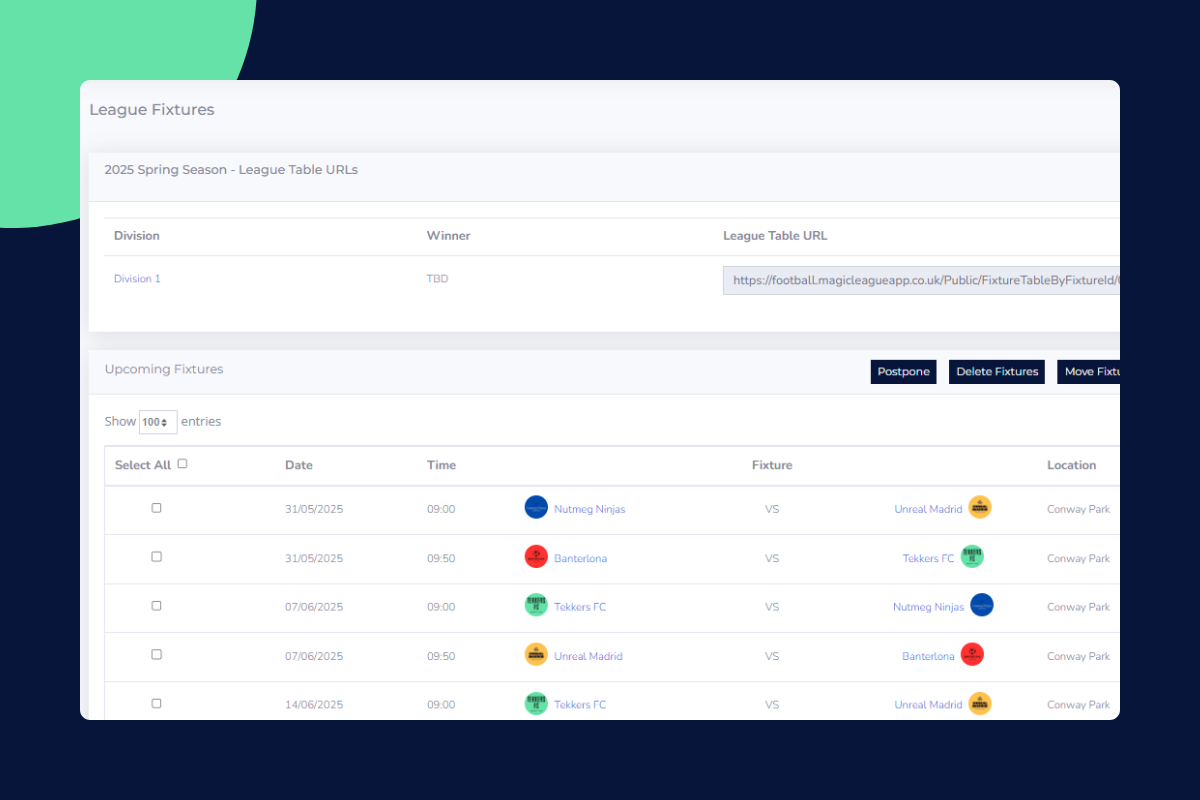
This is the point where all the planning starts to look like a real league. Teams are coming together, the venue is booked and people want to know one thing: when are we playing?
It is tempting to build the fixtures as soon as the first few teams register, but a little patience here saves a lot of changes later. The aim is not simply to produce a schedule. It is to publish one that is stable enough that players, officials and venues can rely on it.
By the end of this step, you should have: A stable fixture schedule, confirmed officials and communications, plus a launch process that everyone can follow from the first match.
Wait until the key details are genuinely confirmed
Create the final fixtures once you are confident about the number of teams, the venue availability and the dates you can actually play.
If you publish too early, every late team entry or unavailable venue date turns into another round of edits and messages. A draft schedule for your own planning is fine, but treat the public version as something people will organise their lives around.
Choose the fixture format that fits the league
The league format itself was decided in Step 2. Here, you are turning that agreed structure into the actual fixture schedule using the confirmed teams and venue dates.
The format you planned earlier now becomes the actual schedule. Decide how many times teams play each other, whether there are divisions, whether you need home and away rounds and whether playoffs or finals sit at the end.
If you are using a fixture generator, make sure it can handle the number of teams and the structure you need. A quick generator is only useful if you do not have to rebuild everything manually afterwards.
Add the real-world constraints
A mathematically perfect round robin can still be a terrible fixture list if it ignores the venue and the people involved.
Add any dates where the venue is unavailable, known breaks, public holidays that matter to your audience and any restrictions you already know about. If teams have genuine availability constraints that you have agreed to consider, include those before the schedule is published rather than treating them as a surprise later.
Think about the matchday flow
Look at the schedule as a league manager rather than just a list of pairings. Is there enough changeover time between games? Do officials have impossible back-to-back assignments? Are teams being moved between courts or pitches unnecessarily? Does the last fixture finish at a sensible time?
A few minutes spent checking the flow can make the first night feel far more organised.
Arrange officials before launch week
Step 2 defined the officiating model. This is the point where you recruit or confirm the people and assign them to the actual fixtures.
If the league needs referees, umpires or coordinators, do not leave them until the fixtures are already published and the first game is three days away.
Once the schedule is stable, assign the people you need and make sure they know the dates, times, venue and how any changes will be communicated. A league can cope with being slightly under capacity; it cannot run a fixture without the people needed to officiate it.
Publish one clear source of truth
Once fixtures go live, make it obvious where teams and players should check them. If the latest version is on a website, do not also keep three different spreadsheets and screenshots circulating in WhatsApp groups.
The fewer versions of the schedule people can find, the fewer “Which fixture list is right?” messages you will answer.
Tell people what they actually need to know
When you release the fixtures, include the practical information that prevents questions later: where the venue is, when teams should arrive, where they can find future updates and who they contact if there is a genuine problem.
Captains are particularly useful here. Give them the key information once and make it easy for them to pass it onto their team.
Have a postponement process before you need it
Sooner or later, something will change. Weather, venue problems, unavailable officials or a team issue will force a fixture to move.
Decide the process in advance. Who can request a change? How much notice is needed? Who chooses the new date? Which teams, officials and venues need notifying? Where is the updated fixture published?
The actual change is often the easy part. The admin comes from making sure everybody has the same information afterwards.
Do a proper pre-launch check
Before the first night, go through the league from a participant’s point of view. Can a captain find the fixture without asking you? Does a new player know where to go? Does the official know which match they are covering? If a venue contact changes something, do you know who needs telling?
Most first-night problems are not complicated. They are small missing details that were never checked because everyone was focused on getting the league launched.
Use the first week as a test, not a verdict
Even with good planning, you will learn things once the league is live. Maybe the changeover between fixtures is too tight. Perhaps players need clearer parking instructions or captains are all asking the same question.
Fix the recurring problems early. If three people ask the same thing in week one, do not answer it individually for the next ten weeks. Improve the process so nobody has to ask next time.
Your launch check
- The final list of teams or players is confirmed
- Venue dates and times are locked in
- The fixture format matches the league structure
- Unavailable dates and agreed constraints have been accounted for
- Officials and coordinators are arranged where needed
- Teams know where the latest fixtures live
- Captains have the practical information they need
- There is a clear process for postponements and changes
- Everyone affected can be notified quickly if something moves
- You have checked the first matchday from the participant’s point of view
Your league is ready to go!
If you have worked through all seven steps, you have done the difficult bit before the first fixture rather than during it. You know there is demand, the league has a clear structure, the venue works, the numbers make sense, people can register and pay, and the fixtures are ready to publish.
Things will still change because this is grassroots sport and grassroots sport always finds a way. The difference is that you now have a structure to deal with those changes without rebuilding the league every week.